Be remembered: distinctive brand assets explained
Think of a brand you could recognise from across a room without seeing its name. A colour, a shape, a pattern, a line. That recognition didn't happen by accident. It was built, deliberately and patiently, by using the same few assets everywhere for years.
Most small businesses never do this. They change colours with every campaign, try a new tagline every year and look like whatever their industry looks like. They are not bad brands. They are forgettable ones.
The short version
- Distinctive brand assets are the colours, shapes, patterns, characters, phrases and sounds that people associate with your business without needing the name.
- They make a brand faster to recognise and cheaper to advertise, because each exposure builds on the last.
- The method is simple: choose a small set that is genuinely different from competitors, then use it consistently everywhere for a long time.
Why being remembered matters
Customers rarely buy the first time they see a business. They buy when they need something, and they choose from the businesses that come to mind. Being remembered at that moment is the whole game.
A business that is easy to recognise gets noticed more, remembered longer and chosen more often. Every ad, post, sign and package adds to that memory, but only if each one looks like the last. Change the look and the memory resets.
What counts as a distinctive asset
01Colour
A colour owned consistently becomes shorthand for the brand. It works best when it is unusual in the category. If every competitor is navy, navy can't be distinctive.
02Shape and pattern
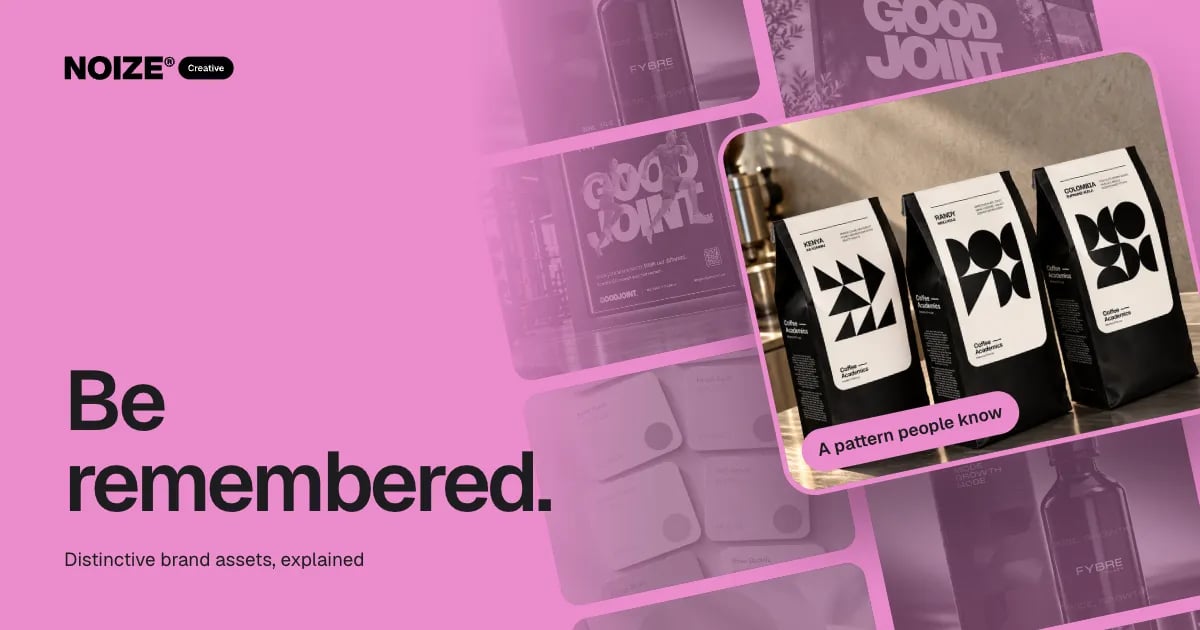
A logo mark, a repeated graphic device, a distinctive frame or a pattern that runs across packaging and signage. Patterns are particularly useful because they work at any size and on any surface.
03Typography
A distinctive typeface or a consistent way of setting type can be recognised instantly, even in a short headline.
04Words
A tagline, a recurring phrase or a consistent way of speaking. Repeated long enough, people finish the line for you.
05Characters, sounds and motion
For some businesses, a mascot, a sound or a signature way things move on screen becomes part of the memory structure.
> I've watched brands I invested in grow faster once they stopped changing their look every campaign. The founders were bored of the colours long before the customers had even noticed them. That boredom is a sign it's starting to work.
How to build them
- Start from what exists. Some businesses already have assets customers recognise. Keep those. Throwing away a recognised colour in a rebrand wastes years of memory.
- Choose deliberately. Pick a small set, typically a colour, a mark or pattern, a typeface and a line, that are clearly different from competitors.
- Use them everywhere. Website, social, packaging, signage, uniforms, proposals, email. The same assets, applied the same way.
- Be patient. Distinctiveness builds over years. The temptation to refresh comes long before customers have learned the current look.
- Protect them. Register what can be registered. NOIZE Legal can trade mark names, logos and other assets once Creative has defined them.
“The branding and concept designs were fantastic.”
Where distinctive assets pay off
They pay off most where attention is short: a social feed, a billboard, a crowded shelf, a search results page. A recognisable asset can register in a fraction of a second, which is often all a business gets.
They also make every department's work easier. Print applies them across signage and packaging. Digital builds them into the website. Marketing uses them to make every campaign recognisable. One set of assets, used by everyone.
Distinctive is not the same as different
A brand can be different without being distinctive. Changing the look every year is different every time, and memorable never. Distinctiveness comes from the combination of being unlike competitors and staying like yourself.
That is why the most effective brands often look simple. A single strong colour, a recognisable mark and a consistent way of speaking, repeated relentlessly, outperform a complicated identity that changes with every campaign.
An illustrative example
Imagine a hospitality brand that has used five different colour schemes in five years, each chosen by whoever ran marketing at the time. A refresh picks one bold colour that no competitor uses, a simple repeating pattern drawn from the logo and a short line that appears on every menu, cup, sign and post.
Within a year, regulars recognise the cups across the street and new customers start mentioning the pattern. The brand didn't get louder. It got consistent, and the consistency made it memorable.
Where to start this week
Look at your last ten pieces of marketing side by side. What appears in all ten? If the honest answer is "only the logo", the brand has no distinctive assets yet. Then look at your three closest competitors and note their colours and styles. The ground they occupy is the ground to avoid. See creative.noize.com.au.
Common mistakes
The most common mistake is changing too soon. Teams see their own brand every day and get tired of it long before customers have learned it. The second is choosing assets that look like the category, which makes them pleasant but not distinctive. The third is using assets inconsistently, so a colour appears on the website but not the packaging, or the pattern is used on social but not on signage.
The fix for all three is the same: a short list of assets, written into the brand guidelines, used everywhere, and reviewed only when there is real evidence they aren't working.
Questions to ask before you start
Ask what customers already recognise about your brand. Ask which colours and styles your competitors use. Ask which assets appear in every piece of marketing today. Ask which assets could be protected as trade marks. Ask how long you are willing to commit to them. The answers shape a set of assets worth building.
Related reading
Common questions
What are distinctive brand assets?
Elements such as colours, shapes, patterns, typefaces, phrases or characters that people associate with a brand without seeing its name.
How many distinctive assets should a brand have?
A small set, usually three to five, used consistently. Too many dilutes recognition.
Should we change our colours in a rebrand?
Only if they aren't working. If customers already recognise them, keeping them protects years of brand memory.
Can distinctive assets be protected legally?
Many can be registered as trade marks. NOIZE Legal can advise once Creative has defined them.
How long until customers recognise new assets?
It varies with how often they are seen, but consistent use over months and years is what builds recognition.
What makes an asset distinctive rather than just attractive?
It is unlike what competitors use and it is used consistently over time. Attractive but generic assets don't build recognition.
Should every campaign use the same assets?
Yes. Campaigns can change the message and idea, but the core assets should stay the same so each campaign builds on the last.
Your first strategy conversation is on us.
Have a chatThe brand for business.