What brand consistency is worth to a small business
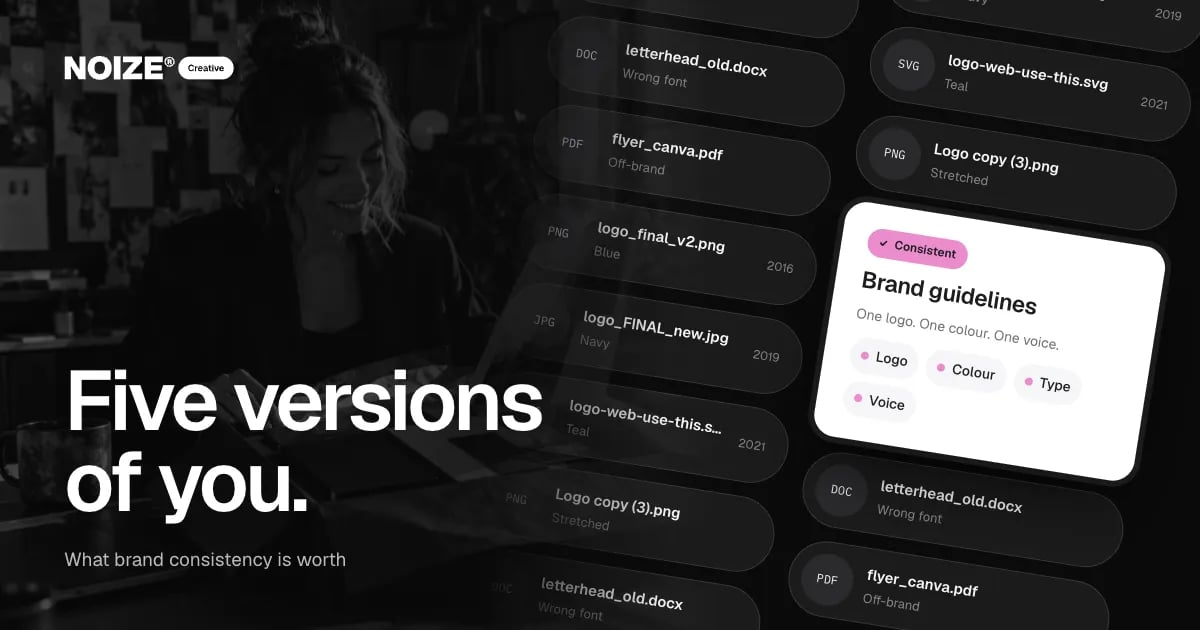
Open the shared drive and search for "logo". Most businesses find something like logo_final_v2.png, logo_FINAL_new.jpg, logo-web-use-this.svg and Logo copy (3).png. Three different blues. One stretched. A letterhead in a font nobody chose. A flyer someone made in Canva on a Friday afternoon.
Every piece looks slightly different. Each one was made with good intentions. Together they tell customers the business isn't quite sure who it is.
The short version
- Brand consistency is worth money.
- It builds recognition, recognition builds trust, and trust is what lets a business win work and charge properly.
- It also saves time internally, because the team stops reinventing the brand every time they make something.
- Clear brand guidelines, the right templates and one team applying them across every touchpoint make consistency the easy option instead of the hard one.
Why consistency matters more than it looks
Customers rarely notice consistency. They notice its absence. A website that looks different from the proposal, a van that doesn't match the shopfront, social posts that look like three different businesses. Each mismatch is small. Added together, they create doubt.
Doubt is expensive. It lengthens sales cycles, pushes customers towards competitors who look more established and makes price the deciding factor. A consistent brand removes that doubt before the first conversation.
What consistency is worth
01Recognition
When a business looks and sounds the same everywhere, people start to recognise it before they read the name. That recognition compounds. Every ad, post and sign reinforces the last, so the brand gets more familiar without spending more.
02Trust
Consistency signals care and stability. A business that controls how it presents itself appears more likely to control the quality of what it delivers. It is not a rational judgement, but it is one customers make constantly.
03Pricing power
Businesses that look established can charge as established businesses. Inconsistent brands get compared on price because customers can't see what else separates them.
04Marketing efficiency
When every campaign builds on the same identity, marketing works harder. Inconsistent campaigns each start from scratch, paying again for attention the last one already earned.
05Speed inside the business
With clear rules and templates, the team produces material faster and with fewer revisions. Nobody needs to debate which logo or which blue.
> I've built ecommerce businesses where the same product, at the same price, converted noticeably better after we tightened the brand across every touchpoint. Nothing about the offer changed. The business just finally looked like it knew what it was doing.
What brand guidelines need to cover
Good guidelines are short enough to use and specific enough to follow. At minimum they cover the logo and its variations, clear space and minimum sizes, the colour palette with exact values for screen and print, typography, photography style, tone of voice with examples, and templates for the pieces the team makes most often: proposals, social posts, presentations, email signatures.
They don't need to be a hundred pages. They need to answer the questions the team actually asks.
“We've had nothing but compliments and praise since making the change.”
Why one team helps
Guidelines only work if they are applied. When the brand passes through a separate printer, web developer, social agency and signwriter, each interprets the rules slightly differently. At NOIZE, Creative owns the brand and works alongside Print, Digital and Marketing, so the same files and standards travel everywhere. When the brand needs to be physical, Print produces it to the same colour standard. When it needs a platform, Digital builds from the same system.
An illustrative example
Picture a trade business with four vans, two shopfronts and a website built five years apart. The vans carry the original logo. One shopfront was updated by a local signwriter who "tidied it up". The website uses a newer version with a different green. Quotes go out on a Word template with yet another font.
Each customer sees two or three of these. None of them looks wrong on its own, but together they suggest a business that has grown without a plan. Consolidating to one logo, one green and one set of templates, then replacing the worst pieces first, costs far less than a rebrand and changes how established the business looks within a few months.
The hidden cost of inconsistency
Inconsistency also costs time. Every new flyer, social post or proposal starts with a search for the right file and a debate about which version is current. Designers rebuild things that already exist. Printers ask which colour to match. Those small delays happen dozens of times a year, and they disappear once there is one agreed system and everyone can find it.
What good guidelines look like in practice
The most useful guidelines are the ones people actually open. That usually means a short document or online page with clear examples of what to do and what not to do: the logo on light and dark backgrounds, the colours with exact values, the two or three typefaces and when to use each, a handful of photography examples and a page on tone of voice with real before-and-after sentences.
Alongside the guidelines sit the templates the team uses every week. Proposal and quote templates, presentation slides, social post layouts, email signatures and letterhead. When these exist, most consistency problems never start.
Where to start this week
Gather one of everything: card, proposal, invoice, website on a phone, social profile, signage photo, email signature. Lay them out together. Circle anything that doesn't look like it came from the same business. That list is your consistency gap, and it usually takes less to fix than owners expect once a clear system exists. See creative.noize.com.au.
Questions to ask before you start
Ask how many logo files are in circulation. Ask who in the business creates customer-facing material. Ask which pieces customers see most often. Ask whether colours are defined for both screen and print. Ask where the templates live and whether people use them. The answers show where consistency is breaking down.
Related reading
- Be remembered: distinctive brand assets explained
- Signs you have outgrown your brand, and what a rebrand should change
Common questions
What are brand guidelines?
A short document that sets out how the brand is used: logo, colour, typography, imagery, tone of voice and templates.
Does a small business really need brand guidelines?
If more than one person makes anything for the business, yes. Guidelines keep the brand consistent when the owner isn't checking every piece.
How do we fix inconsistency without a full rebrand?
Often by consolidating the logo files, defining colour and type properly, creating templates and replacing the worst offenders first.
Who should own the brand?
One person or team should be responsible for approving brand use. At NOIZE, Creative fills that role for clients.
How long do brand guidelines take?
For an existing brand, usually a few weeks. They are often delivered alongside a refresh.
What is the first thing to fix when a brand is inconsistent?
Consolidate the logo files and define exact colour values for screen and print, then replace the most visible customer-facing pieces first.
Your first strategy conversation is on us.
Have a chatThe brand for business.