How brand perception sets your price
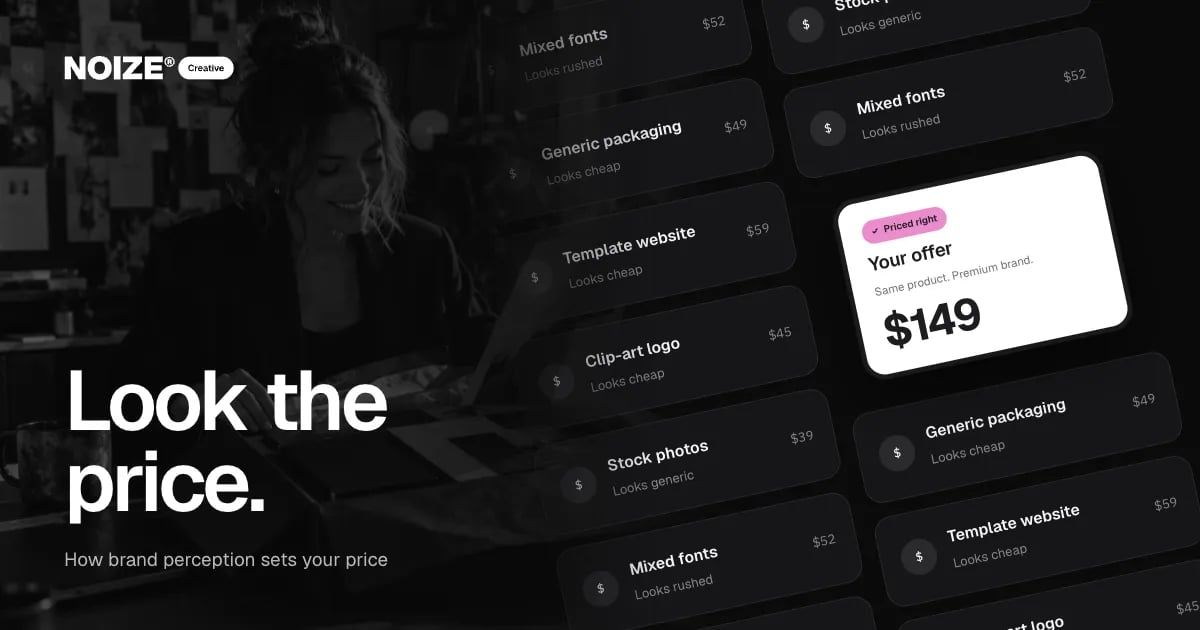
Two businesses offer almost the same service. One charges $59. The other charges $149 and has a waiting list. The work is similar. The difference is what customers expect before they buy, and much of that expectation is set by the brand.
Customers can rarely judge quality in advance. So they use whatever signals they can find: how the website looks, how the proposal reads, what the packaging feels like, how consistent everything is. Those signals add up to a perception of value, and perception sets what people are willing to pay.
The short version
- Brand perception shapes price because customers use the look, feel and consistency of a business to estimate quality and risk.
- A considered, consistent brand signals a business that is established and careful, which supports higher prices.
- A generic or patchy brand invites comparison on price alone.
- Raising perceived value through strategy and design is often easier and more profitable than competing on being cheaper.
How customers judge value before they buy
- Is the website clear and well made?
- Does the business look like it has been around?
- Are the materials consistent?
- Does the proposal feel personal or templated?
When someone can't inspect the work in advance, they look for proxies. Each answer nudges their expectation of quality, and their expectation of price, up or down.
This isn't superficial. It is a reasonable shortcut. A business that takes care with how it presents itself is more likely to take care with the work.
What reads as cheap
01Templates customers recognise
A website or proposal that looks like a hundred others signals a business that didn't invest in itself.
02Inconsistency
Different logos, colours and styles across touchpoints suggest disorganisation.
03Generic imagery
Stock photography of smiling people in suits says nothing specific and looks borrowed.
04Cluttered layouts
Trying to say everything at once looks anxious. Premium brands are comfortable with space.
05Thin materials
Flimsy cards, cheap packaging and low-quality print cancel out good design.
What reads as premium
- Restraint. Fewer words, more space, a clear hierarchy. Confidence shows in what a brand leaves out.
- Consistency. Every touchpoint clearly from the same business.
- Specificity. Real work, real people and language that speaks to a defined customer.
- Craft in the details. Good type, considered materials and finishes that show care.
> I've built ecommerce businesses where we raised prices after a rebrand and sales went up, not down. The product was identical. The customer simply believed it was worth more, because everything around it finally said so.
Positioning comes first
A premium look on an unclear offer doesn't hold. Customers see through a polished brand that can't explain why it costs more. NOIZE Strategy defines the position and the promise first, then Creative builds a brand that makes that value visible. The two together justify the price.
“Seriously, the best branding agency in the country.”
An illustrative example
Imagine a skincare founder selling a well-made product in plain packaging through a template store. Customers like it but treat it as a cheaper alternative. A brand built around a clear position, with considered packaging, a distinctive identity and a site that tells the product's story, lets the same formula sit next to premium competitors. The price rises to match, and the margin funds the next stage of growth.
The maths of perceived value
Raising perceived value is often more profitable than winning more customers at a lower price. A modest price increase drops almost entirely to profit, because the cost of delivery barely changes. By contrast, winning extra customers at a discounted price adds delivery costs and stretches the team.
That doesn't mean every business should simply raise prices. It means the brand should accurately reflect the quality of the work. When it undersells it, the business leaves margin on the table every day.
Where perception is formed
Most perception is formed in a few places: the first search result, the website on a phone, the proposal or quote, and anything physical the customer holds, from a business card to packaging. Improving those few touchpoints changes perception more than a broad campaign. NOIZE Creative focuses there first, with Print and Digital producing each one to the same standard.
Where to start this week
Find the three competitors who charge most in your market. Compare their website, proposal and packaging with yours, piece by piece. Note every place theirs feels more considered. Those gaps are often worth more to your margin than another round of discounts. See creative.noize.com.au.
Perception inside the business
Brand perception affects staff and recruits too. People want to work for businesses that look established and proud of what they do. A considered brand helps attract better candidates, gives the team confidence when presenting to clients and makes it easier to hold firm on price, because everyone can see the business is worth it.
Consistency is part of perceived value
A single premium touchpoint surrounded by inconsistent ones doesn't hold. A beautiful website next to a dated proposal, or premium packaging next to a cluttered social feed, sends mixed signals. Perceived value comes from the whole experience agreeing. That is why Creative works across every touchpoint rather than polishing one in isolation.
Questions to ask before you start
Ask what the most expensive competitors do differently in how they present themselves. Ask where customers first meet the brand. Ask which touchpoints they hold and keep. Ask whether your pricing reflects your real quality. Ask what one change would most improve how established you look. The answers point to where perception is costing you.
Related reading
- Be remembered: distinctive brand assets explained
- Signs you have outgrown your brand, and what a rebrand should change
Common questions
Can branding really let me charge more?
Yes, when it reflects a genuine position and quality. Customers pay more when the brand makes the value easy to see.
Is premium branding only for luxury businesses?
No. Any business that wants to compete on value rather than price benefits from looking established and considered.
What should I change first to look more premium?
Usually consistency and the main customer touchpoints: the website, proposals and anything physical customers hold.
Will a premium brand put off price-sensitive customers?
It may, and that is often the point. It attracts customers who value quality and are more profitable to serve.
Does print quality affect perception?
Significantly. Physical materials are held and judged closely. NOIZE Print produces them to the same standard as the design.
How do I know if my brand is underpricing my business?
Compare your website, proposals and physical materials with the competitors who charge most. If yours feel less considered, perception may be holding your prices down.
Can a rebrand justify a price increase?
When the rebrand reflects a genuine improvement in position and quality, many businesses find customers accept higher prices more readily.
Does a premium brand need a premium website?
Yes. The website is often where perception is formed first, so it needs to match the quality the brand promises.
How long before a stronger brand affects pricing?
It varies, but many businesses notice easier price conversations soon after their main touchpoints are improved, especially proposals and the website.
Your first strategy conversation is on us.
Have a chatThe brand for business.